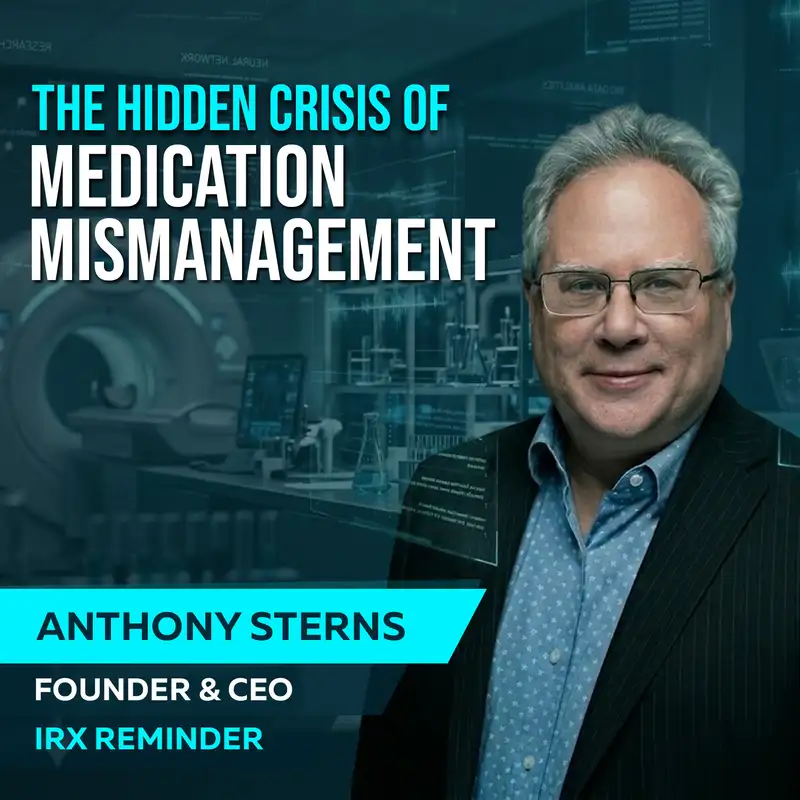
Tony Sterns (00:00)
The kind of harms have remained pretty much the same. About 700,000 ER visits, 350,000 hospitalizations, 125,000 deaths, completely avoidable by taking your medications correctly. That turns out to have climbed from the $320 billion avoidable problem to half a trillion.
Heath Fletcher (00:23)
Have you ever forgotten to take your medication? It happens to millions of people annually and medication adherence is one of healthcare's biggest unsolved and costly problems. Today, we're going to be exploring how one startup is trying to fix that. Well, my guest is Tony Sterns. He's the CEO of iRx Reminder. The company is building a smart medication management technology designed to help patients stay independent and take medication safely. Their platform connects patients, families,
and healthcare providers so medications are managed together. What a great idea. Later in the episode, Tony also explains how subtle changes in behavior can signal when something is going wrong with a patient's medications and how technology can help detect it early and avoid a crisis. Well, let's get started. Please welcome Tony Sterns.
Okay, all right. Tony, thank you for joining me today. Really appreciate you coming on for this episode.
Tony Sterns (01:27)
My absolute pleasure Heath to be here today.
Heath Fletcher (01:30)
Awesome. Thank you. Why don't you start with introducing yourself and ⁓ tell everybody about your company.
Tony Sterns (01:37)
Well, I'm Tony Sterns, the founder and CEO of iRx Reminder. ⁓ iRx Reminder is a platform for medication adherence that's really focused on utilizing AI enhancements to help people remain independent longer, particularly when they're challenged by ⁓ critical daily, the need for critical daily medication.
Heath Fletcher (02:06)
And at what point did you find this vision or this inspiration to go into this venture?
Tony Sterns (02:17)
Well, in my research on dementia, we were seeing that people were losing their independence because they weren't able to take their medications correctly. Sometimes not taking it, but often taking too much. And that would lead to a health crisis. They'd get ahead in their pillbox and end up in the hospital. And then they would move into some kind of ⁓ a senior community following that failure.
And ⁓ I thought there was a lot of technology around helping people, you know, kind of put a fence around themselves. But there wasn't really good technology to help people overcome the limitations of the seven day pillbox and the digital watch combination, which I think is our of as our major competitor. So the the. So I thought that would be an easy problem to solve. And here I am.
nearly 20 years later, right at the edge of solving.
Heath Fletcher (03:21)
20 years in the process.
Tony Sterns (03:22)
It took a long time for the world to catch up with our vision as it turns out. I don't think our intentions have changed much over that time, though we've learned a lot. the problem, I think the problem was always there and understanding that people had trouble taking their medications. The kind of harms have remained pretty much the same. About 700,000 ER visits, 350,000 hospitalizations.
125,000 deaths, completely avoidable by taking your medications correctly. And that turns out to have climbed over that time from around a $320 billion avoidable problem to well over 500 billion.
Heath Fletcher (04:11)
That's just from not taking the drugs either on time or at all. It's just a sort of a misuse of the programs, whatever program they're on, whether it's a clinical trial or if they're actually in some sort of treatment.
Tony Sterns (04:24)
Yeah, just take a look at the pillbox, the seven day pillbox you'd pick up for your grandmother for two bucks at Walgreens or CVS or order on Amazon, I suppose, in the modern vernacular. You know, what you're doing is usually someone else is taking the medications that are clearly labeled and properly stored and placing it into a small box labeled by the part of the day and the day itself.
and taking away all of that labeling information. And then ⁓ sort of having it there as an isolated set of pills that make you, ⁓ you know, feel the need to be well for your, people who set that up. So you, when you skip stuff, ⁓ you want to go back and take it, which is, you know, taking too much. And then if you don't have a good, if you have some cognitive impairment, you're going to lose
⁓ You know, your time sense and everything about the reinforcement is taking your pills. Did I take my pills? And then the alarm goes off. And if you took them early, which is in our research, people like to take it about 18 minutes early. So if you have short term memory loss, for example, ⁓ you might not remember taking it. The alarm goes off. You take it again. Another problem is that if there's a change, right, you have to know to take out the little blue pill and put in the little white pill.
And so usually some people ⁓ don't do that right away or they wait for the week to go out or they start taking the other pill, but they don't take out the other one that's in the box. And so you end up doubling up on something ⁓ that might be bad for you to have more of, right? If you think of a heart medication or a blood thinner that messes with your heartbeat or the thickness of your blood one way or the other, then
And you can imagine the kind of problems that might result.
Heath Fletcher (06:23)
I mean, most of us can relate to that. I mean, it's hard to even remember to take your vitamin supplements every day, but these are, and that doesn't matter if I miss my B12 today, I can take it tomorrow. It's not a big deal, but these are serious things. I mean, if we forget about, ⁓ on a daily basis, and this isn't just affecting, I know you mentioned people with cognitive, so it's not just seniors. I mean, it's people of every age.
Tony Sterns (06:48)
Yes, seven out of 10 individuals, at least in the US, ⁓ are taking some form of prescription medication. So not just those supplements, but medicine that's needed. So that's seven out of 10 humans basically, ⁓ in the developed world, taking an important medication critical to their maintaining their health.
Heath Fletcher (07:10)
And then you could have even more serious things that I can relate to. had a brother-in-law that had a double lung transplant and he's on a lifetime of anti-rejection drugs. it's many pills, multiple pills, a dozen or more in some cases, right?
Tony Sterns (07:26)
So the average transplant ⁓ starts with nine to 25 medications. If it's something like the kind of transplant that your brother had or a heart or ⁓ a bone marrow transplant, they'll usually spend a number of weeks in the hospital. So a lot of help for the medications in the hospital. There's a dedicated team that's giving us things.
Heath Fletcher (07:50)
very
well. My wife had a bone marrow transplant two years ago so I'm very familiar with that.
Tony Sterns (07:55)
So once you go home, you're still on ⁓ nine, usually weaned down to at least three or four consistent drugs for the transplant and that lifelong immunosuppression. But then you might have, you know, diabetes, might have, you know, it might be. So it's the, I think the average number of medications that someone over the age of 65 is taking is around four.
Heath Fletcher (08:12)
Something else could be-
Tony Sterns (08:26)
But ⁓ there are plenty of there's some more than a you know more than eight is often ⁓ If you have a comorbid condition You'll have to double check me on those statistics
Heath Fletcher (08:40)
That's okay. It's a lot of pills. Either one way or another.
Tony Sterns (08:45)
It is. ⁓ And then ⁓ the time of day is also a challenge. Like I said, people in the morning do pretty well at night, less so, but it's the ones in the middle ⁓ that really screw you up. So if you're on a three times a day, you're really in trouble. ⁓ That's ⁓ for epilepsy, for example, anti-seizure medications, at least until very recently, we're three times a day.
⁓ But then if you're taking things you like to take at lunchtime or you need to take middle of the day in order to avoid adverse effects in the morning or at night, then you know there are other complications.
Heath Fletcher (09:31)
Well, let's talk about what it is you've come up with to as a solution to this, because there are things out there. There's things like, you can get bubble packs made through your pharmacy and there's those pop up little cap boxes. there's, like, I you said, there's reminders on your phone or whatever. There are things, but they're, they're not necessary. They're not foolproof.
Tony Sterns (09:54)
No, so I think there are two things that really challenge this behavior of taking your medications, maybe three. The first one is that you do it in the same place every day at the same time. So when you're trying to remember if you took it, you don't remember, because you can't be really sure. So like you walked out of the bathroom, did I take it? I remember taking it every day in the past, but is that a false memory? So there's that. ⁓
So one of the things the pill packs are supposed to help you do is if you look, ⁓ you know, you can't find that day. But they usually, they're not always neatly stacked. They get scattered. And if they're changes, right, you got to take something out and put something in. Those are some of the faults of pill packing. If you have a very consistent schedule and you're good and you only take them in the morning, that is a great solution. Right.
Heath Fletcher (10:49)
Or if you only have a few, right? If you have only a few to take too, because you only have so many in a bubble pack. So you're limited that way as well.
Tony Sterns (10:55)
Yeah.
And as long as they can touch each other, right? Which is another limitation of some kind.
Heath Fletcher (11:02)
Right,
right. can be in the same compartment. Yeah, because that's another thing. Yeah, you're right.
Tony Sterns (11:08)
So the next thing is, like I said, people want to take them a little early. don't like... So when the alarm comes off, you're getting that text message every day that you set on your digital watch or a service. You've already taken it. So you're like, I already took it. I don't care. So you're really training yourself to ignore the reminder. So it just gets weaker and weaker. So it's no longer helpful. ⁓
And if you're good at taking it and you're taking it early, it becomes meaningless, essentially. And then when you really need it to remind you, you're not paying any attention, you probably unsubscribed or turned off the watch. Right? So that's the problem with that. Right. So we created something we call situational smart alerting. So you need something that knows the pill has been taken and you need something to not go off because it knows.
you do remember, or if you're forgetting, it needs to remember. So we call that interaction situational smart alerting. And so we've developed an Internet of Things pill dispenser. ⁓ And we put a dosing window around the time of taking. So when you enter that dosing window in the first half, the medicine's available. You can take it 18 minutes early on average, as we see. ⁓
And then ⁓ you don't get any alerts. just, you take it, shuts down, it's not available till the next window. So if you are forgetting in that second half, that's when you get an alert to your smart environment, your smartwatch, smartphone, your smart speaker. And then if you're actually forgetting, ⁓ we put you on what's called a daily intelligent action list, the dial. And that's shared with the care team. And they can, that...
care provider can make a decision about what to do. ⁓ So we're focused ⁓ today at iRx Reminder on ⁓ serious ⁓ behavioral health diagnoses like schizophrenia, bipolar disorder, depression. So we want to ⁓ make sure that ⁓ those critical daily medications are taken and if they're missed, ⁓ we want to be able to add.
Now, sometimes it might be because folks come in on a weekly basis. You're coming, you're expected the next day. So we might wait to see what happens. But we also might send off a text reminding you of that appointment. And then you should be sure to take your meds before the appointment. It might be we give you a call. It might be in a critical case, like we know you're on probation. ⁓ We want to make sure that.
that you're going to make it tomorrow, we might send the case manager out to your house in the afternoon to see that everything's okay. Now, why do people not take their medication is the next question you should ask.
Heath Fletcher (14:07)
Why don't people take their medication, Tony?
Tony Sterns (14:10)
So often there are a number of reasons. Sometimes they run out. Some they forgot to fill it. So that's another challenge that needs to be taken care of. So, iRx Reminder helps with that as well. Sometimes they feel good and they feel like they no longer need that medication. They're healthy. But some medications are chronic and you feel healthy because you take them every day. Sometimes
more problematic is that you need to take them to be pretty healthy, but you still feel not that great. ⁓ And that is a problem with antipsychotic medications. They're very, they're often very narrowing. So you don't have the emotionality range. And that's good that you can't, you know, feel so bad you want to end your life, but it also means that you can't have equal joy at the other end. Right. So when you're in it,
When you enter a new relationship, and this is another reason, people want to get that emotional range, participate. so being on the dial invites an opportunity to go, hey, ⁓ you made a decision not to take your meds. What's going on? I'm in a new relationship. well, but the meds really mess with my head. I can't be present for that. And I want to be.
Well, maybe we can take it at a different time. Maybe we can take a ⁓ less narrowing medication now that you're in a good place. I'm excited. I want to help. it's that conversation we're looking for. And I think if that's the accountability that you gain from being on the dial, then that's going to be OK. I think everybody's up for that.
Heath Fletcher (15:59)
And this is a one-on-one conversation with a human.
Tony Sterns (16:01)
It could be if that case manager showed up at your door or you got a phone call. Yeah, that's the idea. Uh-huh. So ⁓ What else what else does our ⁓ the last thing is that? ⁓ When you have a box full of pills that with an alarm on it, whatever it might be the big Korg machines or the little ⁓ Simple, you know digital watch on the pillbox as opposed to on your wrist, right?
What I call that the temple of pills calling you over to worship, right? So nobody likes this inanimate object telling you, hey, you're sick. You got to come and worship at me. ⁓ Take, take my offering. So I think that that leads to a negative relationship with your medications. What we try and do with the iRx reminder system is that you get an alert and it it's like you have something to do. You get it where you not from the temple of pills.
Our device doesn't make any noise. Comes from where you usually get alerts to remind you to do something. So, ⁓ I think that's an advance. Plus, you have to decide. You're always making the positive decision. ⁓ I have something to do with iRx reminder. ⁓ not education, not a refill, not a reminder of appointment. ⁓ I have to take a medication. Well, then I have to choose to go there, pick up the device, place it on your hand, tilt it, and the medication comes out.
one of our devices per med. So it's like a smart pill bottle. Right. And that's how it works. So you, and then the behavior itself creates the record. So that's a deming principle I learned in my engineering days that you want to build in the quality is the idea that by taking the medication, you are creating, you're doing the behavior you're supposed to, which is according to Bandura.
reinforcing of that behavior. You're more likely to do it in the future. And then you really create, ⁓ it turns out to be a form of operant conditioning. So essentially when I was on this, taking a daily medication for a number of years before I went to a long-term shot, ⁓ that daily pill, I would wander into the kitchen in the evening and I'd be like, I had dinner already. Why am I here?
And then the light on the pod would come on and I felt like, ⁓ I'm a cat waiting to, for my auto feeder to present to me. So it really does. I mean, I can speak from personal experience that it becomes in the eat and that the, don't really need the alarm very often. And I, I was regularly achieving, ⁓ 93%. Usually you miss once there's a weekend you're out or something. That's always what happens. And in fact, I,
I always found Saturdays to be a problem throughout my researching.
Heath Fletcher (18:55)
⁓
really? Lack of routine for that day maybe,
Tony Sterns (18:59)
Well, so my first study was in stroke recovery. So we had, and this is ⁓ in the early 2000s, 2004 maybe, ⁓ the article that documented this work came out in 2006 or so. But the ⁓ people would go and would have a mini stroke, a transient ischemic attack.
and go into the hospital, they'd have an NIH stroke score less than five and would go home. So they weren't going to rehab or staying in the hospital more than 24 hours. They would go home, but they still had all of the problems of stroke recovery. Their time sense was messed up. ⁓ They were, you know, they would sleep for 20 hours a day. They couldn't focus. So usually they would get three weeks of vacation and then they go back to work. And the minute they went back to work, ⁓
It was too much. They still weren't ready, but that's all the sick leave they had. when we looked at their results, Saturdays, saw 50 % of the missed doses were always Saturdays. And the reason was they were so exhausted from the work week, they just slept through it. And so you could get people into their 90s in terms of adherence if you just woke them up Saturday morning, had them take a pill before they went back to bed. ⁓
Heath Fletcher (20:08)
Is that right?
Tony Sterns (20:24)
So that was, ⁓ you know, that really showed me that, that, you know, different days make a difference. And that's something that you would never see in a blister pack study. No, would know that it was Saturdays that were the problem and you wouldn't connect it to the behavior.
Heath Fletcher (20:41)
very interesting how much behavioral psychology is involved in this. Like I didn't realize that, that, you know, you would, what you've done is connect what, how people behave and how people react to these situations that they're in and how you can adapt, um, your technologies to fit in with them and give them the choice. You know, it's not, you said the word they have a choice because there could be this reminder or that reminder.
but they actually get to make a cognitive choice. it's, I have an appointment. I have to get a refill on my prescription. I got to take my medication. It's now they're in control and they feel empowered by this.
Tony Sterns (21:23)
Yeah, every time. And that's what's really important. ⁓ And that's why, ⁓ you know, engineers think it's a reminding problem. ⁓ I mean, as a reinforcement. But it's a reinforcement problem. It's doing the right thing for the right reasons and reinforcing that and taking ⁓ you work against it when the temple of pills is telling you it's time to take your medication and your
Heath Fletcher (21:33)
Right.
problem. Yeah.
Tony Sterns (21:53)
your D, your D enforcing. don't know if that's even a psychology term, but your D training, the response to that ⁓ when you get a text reminder and you've already taken the medication.
Heath Fletcher (22:06)
So let's talk a little bit about you. So you came, you, you've thought of this idea. How did the business evolve? Like, how did you get to this stage? Now you've, gone through a tremendous amount of work over the last 20 years. ⁓ you have several components and, and, sort of service offerings and the product line. So where's the company at? How do you get me to get me back how you got the company started and bring us up to date.
Tony Sterns (22:37)
⁓ Well, let me jump all the way back. So, I was trained as an engineer in ship repair and overhaul.
Heath Fletcher (22:46)
Hence all your references to engineering.
Tony Sterns (22:49)
Yeah, so ⁓ I'm a University of Michigan engineer. I started my life fixing boats and submarines for the Navy. And I learned a lot about systems and organizational processes ⁓ that don't work very well ⁓ and don't get repeated enough to fix things easily. And that is very much a description of medicine.
So ⁓ there's a lot of parallels between repairing old ships and repairing old people. ⁓ that's my old joke. Yeah, through that process, through that process control,
Heath Fletcher (23:36)
Take away.
Tony Sterns (23:48)
when I began to see, ⁓ when I began to learn about psychology and behavior, the ⁓ phenomena. So five-year-olds are very similar. ⁓ I mean, there's a range, but compared to 95-year-olds, they are, who are not at all alike, they're completely individual. So there's a growing heterogeneity across the lifespan. ⁓
One of those things is your health experience, your health condition, and that very unique to people. ⁓ I mean, we share the same disorders, but we don't share the same ⁓ ability to handle them.
Heath Fletcher (24:32)
Right. To cope. Yeah.
Tony Sterns (24:33)
So we saw this in dementia as well, where people's executive functions fail. ⁓ But very uniquely, know, nobody has the same kind of exact tangle in the same place. And even if we did, wouldn't. Every brain's unique. So I really saw that. But it led to a set of solutions. ⁓
that we call cognitive prosthetics. so ⁓ our early work ⁓ building on the work of Cameron Camp ⁓ applied Montessori ⁓ approaches, which are usually for kids learning to older adults. So ⁓ if you think about ⁓ how to support those cognitive ⁓ works, ⁓ we created in a sense a cognitive prosthetic to help people
⁓ socialize in memory units, a program called the memory magic program, which you can find at memory magic.com. But that that is a cognitive social prosthetic that allows a single staff person to engage positively 20 to 25 people who no longer recognize their children. Right for an hour, ⁓ almost effortlessly. So it's a an amazing
⁓ product, but it really showed me that a small change in process can make a huge difference. So again, we were like, why are these, you know, what are we doing for people at home? We were researching those sorts of things. And I was seeing this problem with medication adherence. ⁓ at that company that developed MemoryMagic Creative Action, we began to do research in this area. memory, ⁓ iRx reminder was basically a tool to do that research.
And then we decided maybe in 2014, 2012 to commercialize it. I guess it was 2012. And then about 2016 or so, we decided we needed a device that would confirm taking. And then about three years later, people started calling that Internet of Things technologies. So we were a little ahead of that, but that's what we have. We have a pill dispenser that does that. And that has gone through
iterations now. ⁓ And then ⁓ we, most recently, we wanted to see if the medication was working. And so ⁓ we wanted to see ⁓ side effects of whether that was working or not. So as I said, we're focused on anti-psychotics ⁓ medications. And ⁓ one of the serious side effects is called tardive dyskinesia. It's an abnormal movement disorder.
And now since 2019 or so, are medications to treat it where there didn't used to be. ⁓ And that will, that is again a daily pill as well. ⁓ So ⁓ we can see, but the idea is that if that starts to emerge that you could do something about it. So we want to spot that, maybe change the medication or lower it down perhaps.
⁓ or increase it if, ⁓ in certain cases, because the, the antipsychotic does mask TD it's, it both causes it and masks it, which, there's a, in move into sort of specialists tell me that everybody gets it when they start taking antipsychotics. It's just not always permanent. ⁓ and it doesn't always push through. ⁓ so you see it even when you're on it. ⁓ but we also can use that same visual AI technology that we've developed.
⁓ to see depression and anxiety. so our partners at Vidara Health help us to deliver that technology through our application. And we ⁓ can see if your depression is changing, if your anxiety is going up or down, and we can react to it. Again, put you on the dial, or when you come in, we can see that change and react.
Heath Fletcher (28:33)
interesting.
I want to clarify something too. So that was the, ⁓ that you're able to monitor. You're able to monitor those behavior changes in people. ⁓ and how, how is that delivered to you? How, do you, how does that information get collected?
Tony Sterns (29:14)
So we trigger an interview on the phone. It's automated. People answer a few questions about their day. And from those responses, we can determine depression, anxiety, a rough indicator of the amount of pain they're experiencing.
Heath Fletcher (29:32)
⁓ okay. All right.
Is there a trigger for that call? there something that
Tony Sterns (29:43)
Well, we usually, it's usually put in, ⁓ as a month, a weekly or monthly. Yeah. So those take roughly two minutes, in the case of TD, but you need to sit, ⁓ as still as you can for 30 seconds in front of your phone and then stick out your tongue for 15 seconds and, and then answer a couple of those. ⁓ how is your day questions going?
Heath Fletcher (29:49)
it's an ongoing update.
Tony Sterns (30:12)
That takes roughly two and half to three minutes to complete. But normally that assessment would take a highly trained psychiatrist ⁓ who has a lot of training to get even to the point of being a psychiatrist. And then to be able to do that or a movement disorder specialist. And the problem is that they're not really training psychiatrists to do those assessments any longer. ⁓
And then they don't want to do them very much because they don't get reimbursed. They like to work in 15 minute incurrence and it takes more than almost 20 to 25 minutes to do one of those assessments properly. Though most people, again, accelerate them. So you can usually spot tarditis kinesia that's severe right away. Right. that, but when you're looking for it at the
intermittent levels where it makes a difference that you spotted early, we hope, because that's the research that needs to be done next. But yeah, it's it's part of our app, it gets triggered and you you respond to the phone.
Heath Fletcher (31:26)
the
app. Yeah. Cause your app you have, you have the device, you have the pill device that, that, ⁓ is provides the, the, the, ⁓ drugs to the patient. And then you have the apps, you have actually a few components to the app, right? A few levels of information that you can collect and then, and they're depending on the individual, what, what level of the applications they're going to be needing access to, right?
Tony Sterns (31:53)
Well, we originally envisioned that there'd be an education component. like when you were recovering from your stroke, you could get that support. ⁓ you, you could see that you were getting better because you were beginning to take more and more of your medication on your own. ⁓ and then that would be an indication of continued support and recovery for the, because that's what you need for Medicare, Medicaid to continue with regular visits. could build podcasts. Essentially we, didn't call them that.
15 years ago either.
Heath Fletcher (32:26)
Information seminars or.
Tony Sterns (32:28)
But our talking PowerPoint, I believe, is what we called them. ⁓ And yeah. And then the cloud, sort of this component that connected ⁓ back to the care team, which eventually also was emerging as the electronic health record or electronic medical record platform.
Heath Fletcher (32:32)
Yeah.
So today, where are you at in the company today? Right now where we're speaking, you've got, what's the offering at the moment?
Tony Sterns (33:03)
Well, we're trying to finalize the transition and cross that valley of death, the chasm, ⁓ from a research tool where all the components have been tested and validated to something that we can grow and scale. And so we have... ⁓
two projects that we are seeking small business innovation research funding for. ⁓ One focused on antipsychotics and one focused on providing support for buprenorphine ⁓ for fentanyl addiction. And those include the necessary funding for contract manufacturing, ⁓ the testing and quality, regulatory quality
management that needs to be set up for that and then the FDA clearance activities that we have. We're also ⁓ doing traditional fundraising ⁓ to support that as well, which is why we were at ⁓ JPM Healthcare this past January and continue to talk to investors on a weekly basis.
Heath Fletcher (34:21)
You know, it's just so that listeners understand too, this is something that it also it's also accessible, particularly the pill dispenser. It's something that is refillable through the pharmacist for a cent or it can be filled by the pharmacist. And so there's other there's other there's clinicians that can be involved. There's it could be clinical studies that this is also applied to as well. So there's a lot of different applications that this can be used for.
Tony Sterns (34:52)
Yeah, absolutely. I mean, we have to pick a place to push on. Sure. We can do the most good. ⁓
Heath Fletcher (34:57)
Are
you feeling good with that now?
Tony Sterns (35:00)
Well, well, I, know, we started with sort of community based medications where older adults are taking a lot of meds as we began in our conversation. ⁓ we, we, found that we, really wanted to hone the technology with a single key drugs. So we turned to heart heart, you know, stroke recovery and heart failure, which would be a particular case where we could work with a single doctor. ⁓
Then we thought, we really need one critical medication. So we turned to oncology ⁓ where people have so oral oncolytics represent ⁓ somewhere closing in on 25 % of all oncolytics now. So we've moved, we're moving further and further away from infusion over time. so that's, ⁓ but people have the same trouble taking their medications. ⁓ The challenge for us was that ⁓
We were having, ⁓ so I had the opportunity to work with the University of Michigan and we were impacting, it was hard to really bring them from the number three best cancer center to the number two best cancer center. So the lift simply by using iRx reminder. So we were looking for a place that had more impact. So we signed up for the National Institute of Health National I-Corps Program and they had us take a look
at behavioral health and oncology and sort of general medication taking and cardiology. And that's where we really discovered this focus on behavioral health. And so the problem there is that behavioral health organizations have about 25 % of their folks disengage from treatment every year. So that's a pretty high turnover.
Heath Fletcher (36:50)
That's huge, yeah.
Tony Sterns (36:53)
It's even worse because it drives a certain amount of the turnover of staff, which is at 40 % because they get frustrated with so many people in crisis and just the pressure of trying to bring people back on after crisis, which takes a lot of time and they just get further and further behind. And that costs about a third of revenue to a behavioral health organization. So if all things went right,
They'd make $21 million with 4,000 active patients, but they only see 14,000. So they're always sort of cash strapped and understaffed as a result. We think that we can turn that around. That's really our value add in behavioral health. But we can increase the independence and stability of the patient for themselves. We give them the tools to be more responsible. And we also...
Instead of just seeing whether somebody comes to an appointment or not, because we only do things in the clinic, we can now know that someone was fine yesterday and is not fine today. And we can direct our very limited resources to helping them stay engaged. And so if we can turn that 25 % into 5 % because people still, you know, I'm fine and I'm not taking this drug anymore. And, you know, and run out of money or disappear, whatever it might be.
⁓ But if we could take that extra 20%, that's a lot more revenue. In fact, it's about 70 % more revenue in terms of the extra work for reengaging. So we really can make a real difference to the bottom line in behavioral health if we can prove that number to the world following investment.
Heath Fletcher (38:41)
So that's what I was going to ask you. So what's preventing you from going there is that investment to help you prove that you can actually reach those numbers or make a be successful in that, in that lane.
Tony Sterns (38:53)
Yeah, we have, so we've done all the development. We're at essentially a design lock ⁓ phase. ⁓ We found our contract manufacturer. We've actually made some of the parts, but we need to stand up a quality management system within, connected to the contract manufacturer. ⁓ Have those, we need to build that quality build process. ⁓ We need to show that that is a successful process by
running a number of batches, which is how you do that sort of thing. Then we report that. ⁓ We use those devices to pass ⁓ two tests, our radiation test and our safety test, which is basically like, it doesn't cause problems with your cell phone and it doesn't kill you if you open it. That's unlike the...
Heath Fletcher (39:48)
That's important.
Tony Sterns (39:51)
Like old TVs used to have that problem if you touch the capacitor at the back, would stop your heart. And I guess if you put it, if you had a powerful enough effect, you could stop the radio from working. Thus the old warnings not to use your phone near the heart machines. Anyways, ⁓ so we have that FDA work to do. And then we'll be able to scale without
without needing to do it under the auspices of an institutional review board, which is how we do the work we're doing now ⁓ as a research project, essentially. But anytime you do anything first in healthcare, you want to research it. So it's not a burden, but it does keep us from scaling. So we have those few things to be ready to grow as fast as we can.
Heath Fletcher (40:29)
Nice.
Tony Sterns (40:48)
And we're raising the dollars to do that. And again, the research work that we're funding through federal grants will support that process. So we'll get there one way the other. I have no doubt.
Heath Fletcher (41:05)
No doubt. Excellent. And if somebody if the check floated down and landed in your lap today to get to to pay for everything you need, how long would it take you then if money was no object? How long would you be before you
Tony Sterns (41:22)
four months to get really the manufacturing process. We're that close. ⁓ And then ⁓ probably ⁓ two to two to three months for that approval. we doesn't stop us from being in the field. So ⁓ six to nine months will have demonstrated that the numbers I need to demonstrate. And then we can take on the next we can take on that series a
Heath Fletcher (41:27)
Yeah, that's pretty close.
Tony Sterns (41:51)
level investment and scale growing from the two to five beta customers to that, all of them, the 15,000.
Heath Fletcher (42:07)
You're so close. It's within reach, hey? Yeah, that's great.
Tony Sterns (42:10)
We've been on that I call it the march of Zeno right where we're where we're halfway so Zeno did the theory on limits There's three Zenos, but there's the Zeno on limits and he was always saying that you would you'd never reach your goal because you can you have to go halfway to get To the goal and so you have to get halfway to get the next halfway and so we were always halfway closer On any given month, I sort of feel but we haven't quite we need that check
to really take that final big step and start on the other side of that line.
Heath Fletcher (42:43)
Right. Is that the, you know, as CEO and is it the toughest part is, is, the pitching and finding the funding or do you have other, are there other obstacles that you find more, more grueling?
Tony Sterns (42:58)
Well, when we're only raising, ⁓ it leads to time to do other things to keep your house and your car. ⁓ And that's true of my entire team. So ⁓ I think the thing that's always challenging is to get funding soon enough that nothing has changed. ⁓ I think in COVID, ⁓
You know, we were in design lock for so long that and because of the supply chain changes, there was a whole new set of technologies. Now we did. The world did wake up to telemedicine. That was a big that was a big and delivered pharmacy. So ⁓ those things that we were always saying wouldn't be too hard. And or we already knew how to solve. ⁓ No. And no one believed us.
are easily solved. ⁓ So that's been going. mean, I've been doing that since 1999 when I proposed to take Palm Pilots and train older adults to use them, ⁓ to remind them to take their medicines and to ask them surveys during the day to see what they were doing. got back reviews that said older adults can't use those devices and they were talking about 50 year olds and 60 year olds.
And then they said, well, yeah. And then they would say that the next iteration was that I wanted to prescribe it across from one phone to another, from one device to another, using the old IR and Palm Pilots. And they said that doctors wouldn't use handheld devices. So I have that framed on my wall.
Heath Fletcher (44:47)
If you had some advice for somebody ⁓ going down this path, what would you offer them? Or if you could give yourself ⁓ your younger self advice, what would you say?
Tony Sterns (45:00)
Well, mean, I take so I'm an industrial organizational psychologist. That's what my PhD is in. ⁓ OK. I'm used to assessing individuals for readiness, entrepreneurship, readiness for executive management leadership. So ⁓ I would say you need to be ready to to float in a world. ⁓ But my ⁓ my wife is not
always ready for my entrepreneurial endeavors. And I'm not always ready sometimes because it takes me away. It challenges me to make priority decisions. you have to also be careful about sticking to your values and what's important and putting family ⁓ at the top. ⁓
and as much as there are times when you're gonna make choices, but you have to be sure you're always being consistent. So I think that's, so when you say what's the advice, ⁓ I think ⁓ the advice I always tend to give is you need to build a team around you so that you're able to pass the torch when you need to pay attention to yourself or your family, right? So that's, ⁓ so you need to build a second family.
around you that is your team so that you can all help each other because there will be challenges there. It will be a roller coaster ride and you will have the rest of your life to manage as well. So if you can build that and they are your second family because they're important trusted people in your company just like you have trusted important people ⁓ in your family then
That's how you survive. I mean, the odds are no matter how close you get, how long you do it, know, only very few of us are going to really walk the full ladder. I've had cousins that are billionaires and I've had cousins that have been and friends and even colleagues who've done this with me who end up bankrupt at one point or another, ⁓ sometimes multiple times. ⁓
So I've been lucky always to have enough support around me to not have that happen. that's the challenge. ⁓ And I guess you need to also have the ⁓ personality to want to do that. There are plenty of people who shouldn't, I guess is what I would say. And I'm sometimes told that I am one of those people. ⁓ Every once in a while.
Heath Fletcher (47:53)
It shouldn't.
Tony Sterns (47:57)
But I haven't taken that advice for...
Heath Fletcher (48:01)
No, clearly not. not. Well, I'm glad you have it. think what you've built and what you're building is sounds extremely valuable and I think the world needs it. So I wish you all the success moving forward. And you know, is there anything else you want to add before we wrap up today?
Tony Sterns (48:03)
You
No, I just, I really appreciate ⁓ the mission. I guess I'd really want to thank those people in my family. ⁓ Dr. Fred Ma and Dr. Owen Muir, Larry Tusick and William Yuan, ⁓ who are the people on my team who really have believed in this idea ⁓ almost as long as I have and help me to keep the mantle. ⁓
lantern raised high or something like that. Let's use that analogy.
Heath Fletcher (48:57)
it's great. Yeah. Well, thank you so much for sharing your story today and hopefully ⁓ someone who hears this will ⁓ will ⁓ want to reach out and connect with you which they can find you on LinkedIn and they can also visit the website which we will provide all those links in the in the details below the episode.
Tony Sterns (49:16)
Well, thanks for the chance to share this information. And I hope it helps some people do the right thing and get to a place where they can be good at reinforcing taking their medication.
Heath Fletcher (49:32)
I look forward to hearing the next chapter. Thanks Tony.
Tony Sterns (49:36)
Have a good evening.