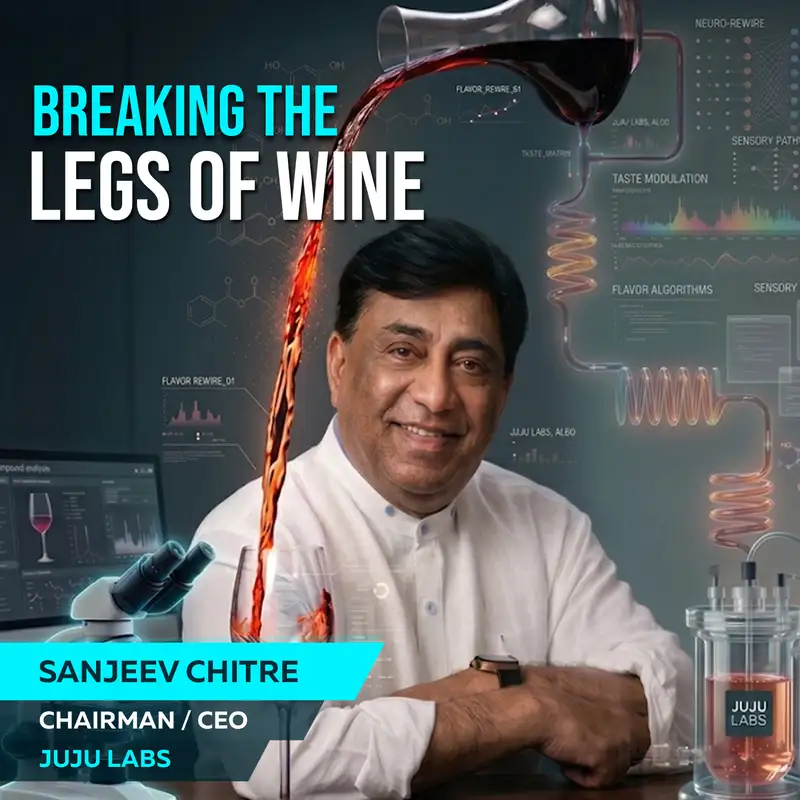
Sanjeev Chitre (00:00)
I said, I want to make food specific wines. He said, you and 10 million other characters, they have tried that and it doesn't work.
Heath Fletcher (00:09)
What if the wine you drink with dinner could be scientifically matched to the exact food on your plate, not paired, but engineered to resonate with it at a molecular level? One man got told it was impossible twice. He did it anyway. I'm sitting here with Sanjeev Chita, a four time entrepreneur, founder of the U group and the brains behind JuJu Labs and next world wines, a category defining scientific disruptor to the wine industry as we all know it.
Later in this episode, Sanjeev is going to describe a moment where his wine was paired with a fresh raw hamachi, a delicate Japanese fish using a red wine. The entire room went silent and a Chase Stadium chef called it something he never experienced in his life. Stay with us.
All right, Sanjeev, great to see you. Thank you for coming on this episode. ⁓ Looking forward to having this call and talking about JuJu Labs. ⁓ we met in Napa Valley, actually in January, drinking wine, as a matter of fact. So it makes sense that we're going to talk about more about that today. So ⁓ welcome to this episode.
Sanjeev Chitre (01:24)
Thank you. Thank you as I was sharing with you earlier that you guide you and Meghna, your partner in this crime at Bullzeye. You have done an amazing job of creating inspirational, creative kind of marketing space. And as you were presenting yourself through that conference, I felt this is a different kind of energy that you bring.
to younger companies which critically need that thinking and that out of the box approaches to be able to bring to the forefront of consumers and also customers because not all customers are consumers. So I enjoyed that interaction and I appreciate the opportunity through your.
you know, sort of network and this podcast to be able to present the evolution of JuJu Lab as a story that was never destined to be a business. So. ⁓
Heath Fletcher (02:36)
Very
cool. Well, thank you. Very, very kind words. ⁓ he said about us. That's very nice. And, yeah, it was, ⁓ it was a perfect store. I'm kind of coming together there, ⁓ during the BLPN conference and, and, I'm looking forward to hearing more about this. So let's, let's start with a little bit about you and your, and your journey. You know, you as a serial entrepreneur and, how you got to this place.
⁓ to embark on JuJu Labs.
Sanjeev Chitre (03:08)
So as an entrepreneur, which potentially is an evolution, I came to this country, you know, with the background in telecommunications and biomedical instrumentation through my college in engineering college in Pune, India. Then as I enrolled myself in Madison, Wisconsin, my purpose in coming to Madison
primarily was to work in the semiconductor fabrication technology, which was at the forefront of possibilities expanding then. And as a complimentary or a minor, I continued to do biomedical instrumentation. so ⁓ post that job, post doing the master's thesis in semiconductor device fabrication for pressure transducers for fishes, you know, to track.
fishes, fisheries, especially how to understand the salmon and things like that. I found myself struggling through the visa process of difficulties that time and got engaged in that journey to a solar company and a semiconductor. Solar is a very simple semiconductor.
Heath Fletcher (04:09)
Yeah
Sanjeev Chitre (04:32)
And so during that journey, began to get, it was because it was a smaller company, I began to get exposed to the power of entrepreneurship, which at times can be a wrong exposure because yelling and screaming doesn't create, you know, the breadth of entrepreneurship, but that's the way what we get exposed to. So then as I understood, you know,
that that is an entrepreneurship thing. Then my next journey was to create scalability of what I had learned into setting up solar production plants all over the world. And that truly allowed me to look at world in a global format where a small young company in Boston, Massachusetts, which was a research and development company for 20 years, then suddenly came into the forefront of.
providing solar production plants all over the world. And a part of that journey, which becomes that, you you have to be fair because the company went public on the strength of solar energy production plants. And there was a disparity of the wealth distribution between the people who helped make it happen and the people who had the ownership of it, which understandable is the part of entrepreneurship.
Heath Fletcher (05:56)
So that's why it's
Sanjeev Chitre (05:57)
brought me to the ⁓ pathway of creating a solar production, a production company, entrepreneurial company, which became the fastest growing company five years in a row. And I was the entrepreneur of the year and we grew from less than a million dollars to nearly 500 million in four straight years and all of that, know, but it teaches you a lot in that journey of what not to do in entrepreneurship, which
brought to you and I together through the book that I published on how to create successful entrepreneurship from an experience rather than just from hearsay. So as a part of all of that growth during those early years of building a rapidly growing company, I was exposed to an auction dinner that I won at the Robert Mondavi's house.
You what it build a wheeling and auction is any idiot can do it as long as they keep on putting their paddle up. ⁓
Thanks.
So that doesn't require any talent as such.
Heath Fletcher (07:15)
But,
Sanjeev Chitre (07:18)
Spirited
at times, you know. ⁓ But in any ways, I was able to get exposure to the Robert Mondavi's reneers at a dinner at his house for 10, 12 of my friends together. And during that dinner that he had created a beautiful setup room with him and his wife.
and each one, they had asked what each one of us ate and our eating habits and stuff. And they served what, four courses of dinner. But each course, everybody had different things because not everybody had meat and things. So each course was a distinct, different dish for those, you know, for vegetarians or the non-vegetarians, meat eaters and things like that. But at every time that a course came in,
he brought a new source of red and a white wine for the dinner in good quantities. So, you know, and he would later taste these wines and it was a wonderful experience. So somewhere after the first thing I got up to say, Robert, thank you for enabling this, but the most, you must be an incredible genius because he said, how did you know that?
we could create a that you would have these wines that would resonate with such a diverse field of foods that you are serving, you know. So he said to me, Sanjeev, don't even go there because food specific wines you all think is a possibility by adding turmeric to red wines or things like that, that never ever happens.
That's why he said we call it pairing. The best we can do is pair food with wines. And he said, but if you want to do something else and open up a wine company in India, would open one. We would do that together. But I was of course running one of the most fastest growing companies. didn't have time for that. that time, my shareholders would take a gun and shoot me if I ever did that shit. So in any case,
Heath Fletcher (09:29)
for that.
Sanjeev Chitre (09:37)
It kept in my mind as to why he made a powerful person in the wine industry, knowing that he was a foodie and a wine, could say the best he could do was create a pairing. And so that was the underlining thought I had. So after the COVID, when things were sort of going a little different, I thought, hey, maybe
it is now time for me to really understand why this science doesn't evolve because just coming to that, when I started the company, I was addressing the challenge that the U.S. government was providing, which is we need to bring back the leadership of semiconductor technology, manufacturing technology from Japan to the U.S. And we had to come up with some level of
I don't want to always call it out of the box thinking, but differentiated thinking that would allow us to do that. And we did. We created the technology of chemical mechanical planarization, which enabled high density chips to happen. And thus for creating rather than a cancer city type of population, a Manhattan type of population on tall buildings on chips with more functions and more.
intensity of processing can be processed on a small surface. Otherwise, your your iPhone would have been half the size today in the room is that were, you know, that was to be used. So I was used to the concept of not, you know, conforming to conventional sciences of possibilities. And so this one, when this challenge, I began to think about
I didn't look at it as anything, what would I have to do to modify the science of wines? Because that would have been an evolutionary step. I said, what is it that is absent in the current winology or the science of wines that is not enabling to make food specific wines, right? And I know it's just this one that you would come to our house, I could give you.
wines that resonate with the food and that was my dream right but obviously Robert had said that it is not possible and it's true because a chef cooks the food that morning while a winemaker start making his wine three five ten years ago yeah how would a winemaker know what you are chef is going to produce today so timeline wine these are mismatched philosophies
And so this is the sort of the fundamental gap in these, not just the science, but the timeline of capabilities. How could somebody know that you would create that kind of a dish today, even if it was, you know, the same dish produced at your house, like chicken tikka masala or some common known dish like that, right? So we had to change something.
fundamentally had to change in the winemaking process because conventional winemaking process would never meet those kinds. And that's what Robert was, you know, enunciating at that point in time. I decided, yes, decided what would I have to do? So I said, you know, let me try to do this in a scientific manner and look at it. So I, because I would never get permission.
from my wife. So one time when she was ready to go to India, I dug under the damn house cave because I knew the fact of life is forgiveness is better than permission. So then, you know, I put together this whole, you know, sort of a version of a cellar, but it was made intended for a lab to be put in there. And then as I went to buy the equipment,
Heath Fletcher (13:43)
I'm...
⁓ I see.
Sanjeev Chitre (13:58)
you know, I, so I do the fermentation company in locally in Los Gatos here. ⁓ he said, so what do want to do? I said, I want to make food specific wines. said, you and 10 million other. They have tried that shit and it doesn't work. And there is, there is no possibilities of doing, I'm not going to sell you the equipment. said, because you are going to fail and you are going to then bring back the equipment.
Heath Fletcher (14:10)
Good.
Sanjeev Chitre (14:26)
and I'm not in the used equipment business, he said. So he said, I'm not doing that. So now that was.
Heath Fletcher (14:33)
There's the first blockade.
Sanjeev Chitre (14:35)
There's
a second now at Robertson's 30 years ago, but now I got the damn problem because I have a gaping hole under the deck of my house.
Heath Fletcher (14:47)
Your bat cave.
Sanjeev Chitre (14:50)
And now I got the bigger problem on my side. When my wife repels, there was no amount of forgiveness that would ever, ever be allowed. ⁓
Heath Fletcher (15:05)
So
Sanjeev Chitre (15:07)
So
when I was stepping out during, and I didn't know why it was the kid, I was, he was of 10 million, maybe an overestimated, but I'm sure a lot of people had tried that stuff, right? Because, you know, it's a common thought.
Heath Fletcher (15:21)
Yeah, someone would have thought. Yeah, for sure.
Sanjeev Chitre (15:25)
Then
I believe that that whole thought process then. I was I was stepping out of the house very frustrated and disappointed. I found a little book that was hanging in there called Fruit Wines. And as I scanned through the fruit wines, it's a little, you know, two dollar book or five dollar book I was scanning. And it kept on mentioning the word umami umami in it. So, you know, I brought the book ⁓
I went home and I started reading. And that's the time when the Japanese had published a massive paper on wine technology. They had said for five years, we've gone through 200 wineries of the world and we couldn't find umami or Kokumai molecules in grape wines. And that, so now here was a huge study from Tokyo University coming through the assessment.
that there is a missing element of umami and kokomais are fifth and sixth sense of taste in the Japanese food culture. So we have the four basic taste of food, which is sweet, sour, bitter. And the Japanese, 100 plus years ago, had invented umami, which is the sense of savoriness. And then kokomai, which is a sense of deliciousness.
Now, savoriness is allocated to dipeptide molecules, whilst deliciousness is allocated to tripeptide molecules of food. So that's why today when you eat food or you see mushrooms added to it or on your salad you add tomatoes, those are all the external additions of dipeptides and tripeptides to create a better flavor for the food.
but it didn't exist. It didn't exist in this wine space, right? you know, wine was so important part of the food. So then we began to really, you know, I mean, I could now at least identify a little light at the end of the tunnel here where everything was based on grape wines.
Heath Fletcher (17:28)
Mine was so important.
Sanjeev Chitre (17:47)
And the paper clearly indicated that such dipeptides and tripeptides don't exist in sensory quantities into the grape vines. And then I was reading this thing about fruit having umami. And so then I looked at what is the only element organ that brings to us that kind of cranial message is the tongue.
right? And of course the nose from an olfactory point of view. The food brings the clean and the nose brings the olfactory experience and the tongue brings the cranial experience. And so then I looked deeply into the understanding of the tongue and very soon found out that at least there are maybe 10 million plus in papillaries or sensors on the tongue out of which
Heath Fletcher (18:17)
For sure,
Sanjeev Chitre (18:41)
40 to 45 % are dedicated in the frontal area of the tongue for the four senses of taste that we have from the food or anything else we eat. The other taste sit in the back for umami's and kokumais. So umami is about 25 % of the tongue and kokumais another 10, 15%. So
Heath Fletcher (19:03)
Where do we find, where are Umami's and Kokami's in our name? Oh, you're coming to that. So I'm jumping in.
Sanjeev Chitre (19:07)
Yeah.
So,
so, so this papillitis now you have a sensor on your body that is capable of understanding the four senses of taste with a fifth sense of taste, you know, on your tongue side and side and deeper in you have the cocumylopsis as you can call them. so essentially your tongue is capable of exploring up to seventy five to eighty percent.
of the food when typically you use maybe 40 to 45 percent if you don't add anything else. So if you have a wine product that doesn't have umami and koku my in it, you are only using 40 percent of the capability while you are having food that is exploring 80, 85, 90 percent of your tongue. So there is a broken
you know, missing sort of this in link between the wine. And so that's the crack. And you know, the Japanese word Kintsugi, it means that you can bring the broken things together through some level of gold or catalyst and cause the Kintsugi experience, which creates the broken pieces.
Heath Fletcher (20:09)
Singling.
Sanjeev Chitre (20:30)
joined together in a much more valuable experience, valuable than the original pieces. So that's why we call the wine experience that we deliver in our through our wines as the Kintsugi experience. We are bringing together the broken science in current wines between wines and foods to create the resonance, not pairing the resonance of food and wine.
And so now that I had the elements of it, now I have to find how do I get them? So then I looking from a science point of view and chemistry, the dipeptides are mostly in fruits. I created a series of, no, so then I went back to this guy and said, I assure you, I am not going to return your equipment. You know, I will sign it, but you can help me.
set up the equipment faster. So within a matter of two to three months now, by the time my wife came back there was equipment and she at least, I did get disasters, know, manageable disasters in the conversations. But now I had the tools in the lab downstairs where I could create this umami wines. And so then I created a series of fruit wines starting from apples and mangoes.
and blueberries and cranberries. And now I had to find out through science, was I really blowing smoke or was it really true? So then I found a lab in the ⁓ Arkansas at Tyson Foods that had the only equipment in the US that could detect these umami's and kokumai molecules because they're in parts for billions. So we partnered
or ask them to do a service for us to take these wines and see if they could track umami and molecules on it. And in the meantime, we also found that coco-my molecules exist in tripeptides, exist in vegetables and nuts. So then we created the vegetables out of cilantro and jalapenos and cauliflower, a series of these.
to do the same thing for what you would consider as Kokumai wine. So now the Nab JuJu Lab, we'll come to the name white JuJu, but JuJu Lab, rather than a winery or anything made sense, because now we were looking truly, truly unknowing of the history of wines and how the church made wines or how Napa Valley makes wine. It was irrelevant.
Heath Fletcher (23:04)
But
Sanjeev Chitre (23:23)
because we were focused on the science of wine, which is the oneology, and we were relatively looking at it with respect to food, rather than just as making a great wine. So that's kind of the difference that we said. So as we send these out, we could actually watch on the data, the umami molecules coming at a different sense.
the from different fruits. now we have the fruits. To identify what your tongue is tasting to be to be processed or infused, we call it in the wines. And so then we had a long spectrum of what was available as tools from dipeptide molecules and then what was available from the tripeptide molecules.
Heath Fletcher (23:55)
we have the tools.
Sanjeev Chitre (24:20)
So although this is a science nonsense that we are talking about here, I know people don't care damn about science, but, but, but I want to.
Heath Fletcher (24:30)
Well, this people, this audience likes the science for sure. Yeah.
Sanjeev Chitre (24:34)
We will relate to the practical aspect of it. But what I wanted to share with you is it was driven through this innovation of finding things that were literally there. And if the Japanese in their papers, instead of just saying, no, you don't have umami grape wines, they gave me the clue how to bring the absent versions of the molecules now.
The biggest pain in the ass in this is the alcohol board. know, because alcohol board does is so I mean, in a nice way, in a good way, but it's a pain in the ass for innovation because they don't want any thing that is different than wine to be called wine molecule. And 99 % of their data plus is based on grape wine. And there are some fruit wines or sangrias, but
You know, they are just a very small percentage of it. So we then invented, because of my knowledge in semiconductor and chemistry, I was able to lay out a process where I could actually take a fruit, or what you call as umami molecule, and begin to infuse it into the grape molecule. But I found out in the early stages.
that it is not that easy to create this infusion process because in a 750 ml bottle that you buy at the store, only two to 3 % of that is called flavones and flavonoids. The remaining is just alcohol and water. So 97 % of the price you pay for your wine, you're just paying for alcohol and water. And the two to 3 %
that's flavor once and flavor notes and Easter is the true value of that sensing of the taste of the wine. Right. So now. No, no percent. Absolutely.
Heath Fletcher (26:36)
more than 3%.
Well, I'm blown away. I didn't know that.
Sanjeev Chitre (26:42)
It's
it's it's but you see it makes us because now we had to focus only on those two to 3 % to create a change or the other difference in the wine. by adding a few milliliters of of so-called the umami's and cocoomized infusion process, we could create a different taste in the entire bottle or the barrels of wine. So now we had an ability.
Heath Fletcher (26:45)
sense for
Sanjeev Chitre (27:12)
And we called it the essence de juju, means the basic sense that creates the transformation of taste, right? And so now we have the tools, we have the data to see how your tongue, so we can take your food, we can run it by the meter, shows where the umami peaks are, we can add, we can bring those peaks through the wine into the grape wine.
And now you will create a perfect resonance between wine and food. So when they call it pairing, which Robert Mandavi 30 years ago was saying it was one plus one equals two or three. We, when we call it resonance is one plus one equals nine or 10 because remember that 10, 20 % of the tongue is still left unattached or unexplored. And there may be a seventh.
taste of food, is not today, but maybe tomorrow it get. So that's why we call our wines as resonance between food and wine. So what we bring to you in the creation of the food and wine is the experience of harmoniousness between food and wine. So the JuJu Labs then became the sort of the go-to thinking science.
that allowed us for the manner to bring these dipeptide, tripeptide molecules into grapevine. But we needed the science and the science lied in this whole megasonic ultrasonic capability. The challenge that, and I don't want to go into writing a PhD thesis here, is that, so is that when you,
Heath Fletcher (28:59)
Peace.
Sanjeev Chitre (29:03)
Good. You buy a 200, 300, 500 dollar bottle of wine and the sommelier opens the damn cork and he pours the little wine and you swirl the damn wine and you look at the leg and you say, wow, you know, that's slow flowing wine. You do not realize that those legs of wine are the most useless things in tasting that wine because those phenolic compounds actually form a barrier.
Heath Fletcher (29:20)
later.
Sanjeev Chitre (29:33)
between the molecules that are enabling to taste the wine to create the resonance between the food. So in reality, we have to break those phenolic compounds to create a bond between the food, between the umami's and the Kokumai. So all that science that was proven through the leg is gotta be one of the most accepted blindly science of life.
where those phenolic legs are the worst thing for creating a perfect taste between the food that the chef has made to the wine that has been created. know, I'm, I'm, I'm, I'm
Heath Fletcher (30:17)
Now you're breaking legs.
Sanjeev Chitre (30:19)
Now we are trying to unleg the wine.
Heath Fletcher (30:29)
So.
Sanjeev Chitre (30:30)
So now the other aspect of because we began to understand this, then, okay, so what can we do about the whole thing of aging? Because the whole industry of wine believes that aging is the expensive process, true, because you're using caves and dam barrels and like that. And the process and the expensive, and that's why when a wine is
Heath Fletcher (30:51)
There.
Sanjeev Chitre (30:59)
maintained for 10 years you pay $500 and when a wine is maintained for one to two years you pay 10 to 20 dollars 25 dollars and so 95 97 percent of the wine is sold that is made within the two to three years the what you call as the wines of the snaps is fundamentally about two to three percent of the overall marketplace. Now the
Heath Fletcher (31:26)
Thanks.
Sanjeev Chitre (31:26)
That's the numbers of the commercial level. But here is the reality. I can age a wine in two to three days and best one week that would you take conventionally for you five to 10 years to do through science, right? Because aging is again cranial aging, which is the maturity of the wine.
And then you have what you call olfactory, is the sensing taste. Now the barrels longer the barrel, the more sense of the word that goes in because it's time dependent. Right. And the aging, the phenolic compounds take time left itself to mature. So by separating the cranial aging and the olfactory aging in two serially operated units, we can age the wine in a very short
time, can actually see the maturity of the Hawaiian occurring, occurring within the first two to three days. Because again, when we break the bond, the phenolic compounds allow the maturity of the wines that are broken up by cavitations through megasonic allow the bond to be happening faster. So the wine matures and by flowing the wine through not through barrels of grubs, but by creating blocks and tubes.
in which the wine can be made to flow, you allow the oak to go and merge into the wine faster. So with a tabletop unit, like what we call the infuser, you can create the wine maturity in a very short period of time. And we are not asking that you replace your caves and barrels and things like that, but we are asking.
for those wine lovers who want to taste great wines, would go with amazing foods at a fair, affordable cost to be our sort of the clients. Because we are not, we are here for the masses or what we call as the hubs and not for the classes, which we call as the snaps.
Heath Fletcher (33:40)
Hops and snobs.
Sanjeev Chitre (33:43)
So that's the sort of the evolution of JuJu Lab. And what we do is we take the currently we started working with the Mandawees because we were also initially partnered with Mardi Gras because they tasted the wines and we created wine cans for the king wines and the red wines, the queen wines as the white wines. ⁓ really, okay. And in cans for Mardi Gras.
in an exclusive license with the Martingale organization. And that led us to get introduced to Napa Valley, where I got introduced to Angelina Mandavi in one of the wineries. And she said, this is not possible. And then when she came and looked at the science, she said, you know, I'd love to help you create a brand. And that's why when we use the Mandavi wines as our base wines.
Our brand is by Angelina Mendavi.
Heath Fletcher (34:44)
And that's an important clarification too, is that you are using existing wines as a base for what you're doing to taking it. So that's why you can have various brands that are using their base, but then they're using your science to manipulate the wine.
Sanjeev Chitre (35:02)
Yes. you know, transform is a better word. Manipulations, you know, because we don't add any external chemicals. Right. We don't, we don't, we, there is no chemistry. No, that is, you know, that I reduce or anything. We bring wine to wine. So it's like, for example, when you buy a blend of Merlot with, with Cabernet and things like that, you, you
you don't manipulate it's a wine. But in that case, they are essentially added to it. We actually break the phenolic compound simply to create the bond between the umami, kokumai types of wine molecules to give you that enhanced taste. that's the sort of the basic. And we don't recommend that you drink our wines just as a wine tasting.
event, we don't want it to be on the Safeway stores because that is not a place for us. Our place is the experience of food with wines. that's why we work with the banquet companies. We work with private chefs. You know, where there is an experience to be had of food and wine or what we call as food resident wines. So it was, you can see, I can send you a video.
So about two years ago that Angelina and I were in London with Michelin Star, three Michelin Star restaurant chefs with one of the bigger brewing companies called Vijay Mallya, was the Kingfisher staff. He had invited a whole bunch of people at the restaurant and Angelina got up and said, 30 years ago, my grandpa told Sanjeev that food specific wines are an impossibility. I'm here to tell you that through science.
four specific wines are now coming to be a reality. And then we got amazing testimonials from three Michelin star owners and stuff like that of these wines. And that's the beginning of the journey of JuJu Labs.
Heath Fletcher (37:13)
Very interesting. In fact, think one of those was, you also, one of those experiences was ⁓ from a chef at Chase Stadium. Is that right?
Sanjeev Chitre (37:22)
Yes,
so now of course we are getting a little bit more confident, right, of what we have in our stuff. So then we invited at a private tastings of the entire 12 team at Chase Stadium with the Golden State Warriors play and they wanted to create a diverse cuisine experience and then obviously then their whole director of foods and it was a
massive undertaking that they had all come and we created the wines. And for the first, the director of food, for the first time, you are enabling the hands of the chefs to be freed because till today we have to tell chefs what food to make based on what wines we are going to serve. No kidding. Driving the menu. Right now the wine is driving the menu and now
Heath Fletcher (38:14)
The wine is
Sanjeev Chitre (38:20)
we can have the menu being driven first and the wines can be made to add. And so the focused, the experience that really they focused on because it is one of the most difficult elements was the Japanese foods. because, they took hamachi, which is a fresh fish that doesn't really very difficult to match with anything. At best it can do something with white wine. And we...
we created a perfect resonance between hamachi and a red wine and the whole floor was just totally, you know, killed because I've never seen, never tasted this food. So it is because we are playing with the science on your tongue and we can create that. So we call it the culinary onyology, which means the science of wine.
used for culinary experiences. So hopefully in a short period of our journey, you would go to a store and say, today I'm having Japanese food and you will have the juju wines for Japanese food. That makes sense for us. But just now to compare with the conventional wines does not make sense for us in the commercial marketplace.
Heath Fletcher (39:44)
Culinary on a, a ology is incredible statement. And what, what chef doesn't want to have their food come first.
Sanjeev Chitre (39:54)
Right. Yeah. So we are also now enabling the chef to have their private label wines. Yeah. One of the things I want to share with you, the transformation of what we have done to the economy of wines. Right. And that's an important story. entrepreneurs as such measure their disruption through technology. But entrepreneurs like Uber.
Heath Fletcher (39:59)
Wouldn't that be something?
I'm sorry.
Sanjeev Chitre (40:24)
measure the air B and B measured is a disruption through the economy of population and the ease. So I wanted to sort of shift your view a little bit from the bandabi base of wines, right? Because we are good at that to be able to see why only mandabis nothing, no right or wrong, just a thought process of democratization of wine.
Because as you know, the in the marketplace of about 12 to 15,000 wineries around in the US, nearly 75 to 80 % of those wineries are under the boutique winery category. Now, what do I mean by that? So if a winery is shipping more than 50,000 cases a year, it gets qualified in
through the level one category on the big wineries space. Then if they ship the between 5,000 to 50,000 cases of wines, they fall under the mid-level wineries, know, medium winery things, right? So, you know, you have the Mondavis, the Gallows on the big side, the Yellowtails. And then you have the Robert Halls or, know, Catherine Halls and things like that.
Heath Fletcher (41:26)
Right.
Sanjeev Chitre (41:51)
in the center of it, but 75 plus percent of the wineries in the U S are called boutique wineries, which means that they ship less than 5,000 cases as the batches. The economy today has impacted these small wineries to a disaster point because they don't have
Heath Fletcher (42:05)
Small batch. Yeah.
Sanjeev Chitre (42:20)
the momentum or the ability, the marketing budgets to required to be able to create a sustainable transform, you know, living in this space. So it comes and by the way, whatever we are doing in the change of wine, we categorize them under the next worldwide because there is no category for what this all of the food.
you know, the relevance of wine is so we call it and we own the brand called the next world wines and the next world wines are designed for the younger generations, the wine lovers who don't like the obnoxiousness of, know, talking about the leather in the wine and, all that stuff. It is so subjective to the process. I told you, the damn thing you have to unleg
the wine to really experience the wine, but you can have a 10 hour conversation in sommeliers about the legs of the damn wine, which in science have absolutely no relevance to the taste of the wine on your tongue. It's like pouring acid on your tongue and not making it feel the true extent of the food, right?
Heath Fletcher (43:41)
It
taste great, but it looks good.
Sanjeev Chitre (43:43)
Well,
it gives you conversation. Yeah. Doesn't matter. We are not in, as I said to you, we are of this for the classes for the masses and not necessarily for the because that is not our space.
Heath Fletcher (43:58)
doing.
So
Sanjeev Chitre (44:00)
where I was going with this thing is this boutique wineries. What we can, they have a hard time expanding their product lines because they're grape lines. Grape wineries are fixed. So by taking their wineries and bringing to them the science of essentially juju and enabling them to create a category of wines with their own base wines.
Heath Fletcher (44:26)
Right.
Sanjeev Chitre (44:26)
that bring the culinary experiences to their wine club members and their tasting room attend people and their event centers. We can create a vibrancy of economy and business into the words of these people to that what you call as as the boutique winery business. And so we are doing it in two ways.
we are bringing what we call as the balloon and barrel experience, which is just a marketing capability of a 20 foot barrel with a hot air balloon on the top of it just to create a recognition. But this is the bullseye marketing recommendation. Right. So our issue to grab the attention, the attention, Gaspar, is because we want you to come and just experience the thing. We are not telling you science.
Heath Fletcher (45:14)
Right.
Sanjeev Chitre (45:25)
We are are we are we are selling you we are enabling the experience. So whether you are having a 30 people party at the event center or you're going to the tasting room or you're going part of the wine club, we can enable an expansion of revenues through this science that we call as the culinary or neology. The basic element being the sense to do and we create that.
for you locally by having these kinds of, you know, ability to modify the wineries or to enhance the wine tasting. So we, our marketplace, why? Because every boutique winery has spent 10, 15, 20 years on establishing a wine club. And they have wine club membership of anywhere between 500 to
Heath Fletcher (46:15)
Exactly.
Sanjeev Chitre (46:21)
2,500 members. There is a number of buyers that are creating that and they love their base wine. So here is an extension of the capabilities that they can enjoy the wine, the drinking. But when you sit on the food table, we will create the same wine, create a different, extend that experience for you. So therefore allows the boutique
Heath Fletcher (46:24)
That's a dependable...
Sanjeev Chitre (46:50)
wineries to now offer the next world wines in addition to their original wine formulations under their own name. And that is our sort of the roadmap to grow through this space, you know, by offering the science of enabling the Kintsugi experience into their existing wine infrastructure and to
bring them better margins and more expandability. And that is what our go-to-market philosophy is.
Heath Fletcher (47:28)
Now, JuJu Labs, didn't explain where the name came from or what it means. We about that earlier.
Sanjeev Chitre (47:34)
Well, we spent $2 million on getting the name JuJu. You can believe in that bullshit. Or, or, you know, my daughter who is, you know, not 34, 35, her name is Avantika. And when her nephews and nieces over a year or two years old, couldn't call, say Avantika. So they called her tutu, you know, tutu auntie. Well, my genius wife who said,
If you are going to call her Tutu, you can call me Fufu. Right, as a name for them to say. So I was the only character left out. So I said, well, if you're going to call her Tutu and her Fufu, you can call me JuJu. That was all the brilliance that went into.
because remember it was only to be as a lab as an experiment. So I didn't care what it was cause I called it juju lab. It was my lab. could call it anything. A year or two later, I found out that in Hawaiian language, juju means joyful happiness, good energy, all that kind of stuff. But
Heath Fletcher (48:34)
yourself.
And then...
Sanjeev Chitre (48:52)
That was not where I had to spend my million dollars to get the name. So that's the story behind the JuJu Labs.
Heath Fletcher (49:01)
And then extending on that is the essence of juju, right?
Sanjeev Chitre (49:06)
See, because the essence of JuJu is fundamentally what creates the transformation. And now we have, we are creating with a very large Japanese company, the equipment on a commercial scale that will go into large or medium and future wineries so they can transform their own wines into the next world wines. And we call it the Infuser 747. It has nothing to do with the plain 747.
it has to do with take seven types of base wines, which means Cabernets and Merlot's and which also includes the white and the reds. And then these wines on the input side have a essentially JuJu that is added to them to go through four types of processes, which are essentially.
the infusion, the aging, the maturity, and we add small amount of carbonation because carbonation in 0.2 to 1 % creates a vibrant sort of infusion process. And that equipment, we call it, and it creates seven different kinds of cuisine wineries from that. So that's where the name 747 came.
So because we want to be able to create, to give the wineries, you know, standard, formulated, repeatable, you know, designed wines for culinary. So you can now have a Japanese wine out of the same kind of tools or Indian foods or Chinese food or Taiwanese, Italian foods. And, you know, so that's where the categorization of the thing came about. So we would.
We would buy early. We are in the process of building the commercial version. We did this experimental version prototyping in our lab here. But now we are building and would need a significantly established science company. So we were fortunate to partner with one of the largest Japanese companies who was looking to diversify their business from the semiconductor space to another industry.
And this is as big an industry as you can get in that space.
Heath Fletcher (51:32)
Very interesting. Wow. What a story. I mean, it is so intricate and interesting that it, I mean, I don't think you could get any more details. We've already done that for 50 minutes of this, but we've covered, think, a lot of it. But Sanjeev, it's been an incredible story. What are you seeing now? What's coming up? What's happening next? Where are you at in all of
Sanjeev Chitre (51:57)
Yeah.
So we are in the early stages of our technology transformation, you know, and as you know, the challenges always are everybody today is AI, AI, AI, lots of money going into the space. If we do have an AI model that would integrate the foods and the flavor on flavonoids, but that is the underlining added to the enhancement of our technology.
And because nobody cares if you're drinking an AI created wine, but can we create a better resonance between food and wine? yes, so we are using Korea, Korea, of Korea, South Korea came up with a twin Siamese model of AI. We are working to implement that process in it at the next stage of evolution, because we just have to keep on pushing.
the envelope of preciseness, you know, to create that better and better experience. So that's on the sort of a development side. On the commercial side for us, we are working to partner in each. So all of this 11,000, which are the seven, 8,000 wineries are boutique. They are distributed in about 45 to 50, what they call as the American, white culture locations.
which means that in each area they have 25 to 30 plus more wineries and we are working to starting with Livermore here which has 200-300 wineries we are beginning to work with as a pilot scale with a winery to be able to start the process of working with their existing wineries. Our approach is to
go into these regions and enable in two ways. One is to provide our essence to JuJu services for other Labs, for them to give them the next worldwide. When I'm in the boutique wineries and or to have people come to our own event centers under the balloon and barrel brand where we would be, you know, sort of, I don't want to use the word, but managing
the boutique wineries, enabling the event experience. So you could come to have two-hour plays, could come to have an Italian event and we will create a barrel to table Italian food specific experience, which is never possible in any part of the world because the essential juju makes that possible for that. So you can tell us a week, two weeks in advance that you're having
50, 100 people for having an Italian celebration. And here is the food that you would choose and we would deliver barrel to table that experience for you. Right. And so we want to, that's what we are working on this year. Our goal is to, you know, focus on it, make that workable. I'm sure there will be glitches in the process, but expand the offering for the tasting room.
Heath Fletcher (55:02)
So, yeah.
Sanjeev Chitre (55:19)
bring the expand the offerings in the wine club, bring the event centers to the space where it's an experience. And if you see the balloon and barrel sign big display outside, that's where it's a go-to experience for that place. And then we hopefully will create scalability of that in different wine regions of the place. And that is our growth model, you know.
Heath Fletcher (55:48)
And those are happening. Those are all already happening.
Sanjeev Chitre (55:50)
Yeah,
what is happening currently is we are focused on the Livermore area and our plan is to get one of these locations up and running and optimized and then focus on another three to four next year. So that's the scalability portion.
So that's because, we are a young startup company and we have to manage our capital resources. And it is not easy to raise money, even for such a growth space in this because of the whole money has been sucked into there. And we don't want to mislead people. We do use AI, but AI is not our business. Our business is to sell amazing wines with great food tastings.
Heath Fletcher (56:42)
Right. And what are your immediate roadblocks right now and what are you looking for at this moment?
Sanjeev Chitre (56:49)
So other roadblocks are ensuring that what we see and do are repeatable in the infrastructure that we have. So we have done this in pilot quantities. We have to do it on scalable quantities of membership. that's what we know we have done. are producing wines. are labeled. And Alcohol Board was ⁓
Heath Fletcher (57:10)
Great.
Sanjeev Chitre (57:19)
a roadblock because they took typically takes two to three weeks to approve a wine formulation. It took us 11 and a half months to get the first formulation approved through the alcohol board because we were pushing the envelope of science. But they claim now they can do it in three to four weeks. And we are working through that. It's that I don't think that's a major roadblock. Our major roadblock is the engagement of people in this new concept, which is a mental state.
⁓ It is the actual experience of the tastings of the difference of the wine and then get the next the next world the new lovers of wine engaged because There is not enough interest in old wine science That's why you are seeing the wine Lovers of the younger generation getting detached and they're going to hard liquors and stuff like that. So hopefully But you don't drink hard liquors
with food and everything like, know, can bring back that experience to them and engage while they keep their habits of enjoying the hard liquor, but sit at a table and create a beautiful dining experience. So that I don't think it's a roadblock, but it is a transitional reality that we have to manage.
Heath Fletcher (58:21)
that.
Right. And you have to somehow turn that into the opportunity, right, which is the core of being an entrepreneur.
Sanjeev Chitre (58:47)
which is a part of living the life of an entrepreneur.
Heath Fletcher (58:51)
That's right. Okay, well, where if people are listening and they want to find out more, where should they go to learn more and
Sanjeev Chitre (59:02)
Yes,
so we have a website of course jujuwinelabs.com. Okay. ⁓ And the science and we are a little bit protective about it right now. you know, we will share whatever we believe is, you know, known to be. But just ask us come to tasting Labs or write to us and we will figure out how we can share.
Heath Fletcher (59:14)
course.
Sanjeev Chitre (59:30)
some of the wines and stuff like that because we have a wine club through which we can ship the wines. Yeah. So we have a wine club which we can ship the wines through. So, so JuJu Wine Lab and I believe our, ⁓ we have a contact information which is Renee Godge and Sonal and we'll, you know, maybe we can put it on the.
Heath Fletcher (59:36)
is that right? Nice.
Put
all this information in the notes for sure so that people can click away and go there for sure. And they'll be able to find out about events happening wherever they are as well. yes, yes. Well, amazing. So thank you so much for sharing this story, Sanjeev. I am looking forward to tasting it. Of course. haven't had the opportunity yet, but I'm looking forward to that moment and seeing where we go in the next, in the coming months.
and years with juju Labs and the next world wines i love that the culinary oniology some great words it's something about having new words to say too that's right we cannot we cannot explain
Sanjeev Chitre (1:00:34)
This is the new science, right?
new
flavor, new world, new horizons to explore. And they have to be identified with a different terminology. And Kalanadi oneology should be a term at the Kalanadi Institute of America. And we are, and we will continue to work with them to make this a whole, you know, a whole, a word at every home, you know, but today it is just beginning.
Heath Fletcher (1:01:07)
Well, thank you so much.
Sanjeev Chitre (1:01:09)
Thank you so much.
Thank you for the opportunity, my friend. And he can look forward to many more such interactive sessions.
Heath Fletcher (1:01:19)
As do I.